A Faith-Based Presidency

Despite two bestselling autobiographies discussing President Obama’s faith, many Americans remain confused and, frequently, skeptical about the President’s Christianity. Last week, John Blake tried to set the record straight at the CNN Belief blog. I recommend his thorough examination of President Obama’s religious beliefs in “The Gospel according to Obama.”
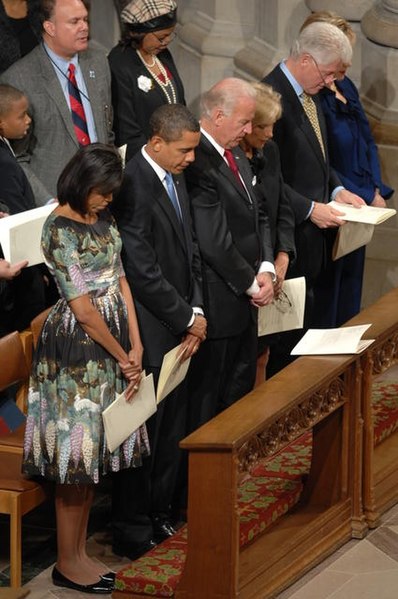
National Prayer Service during President Obama’s Inauguration with First Lady Michelle Obama, President Obama, Vice President Joe Biden, Dr. Jill Biden, former President Bill Clinton and Secretary of State–designate Hillary Clinton, January 21, 2009. Photo credit: U.S. Army Staff Sgt. Adelita C. Mead

Blake rightly locates Obama’s religious identity in the history of liberal Protestantism, especially the Social Gospel, and African American Christianities. Blake sees the influence of Martin Luther King, Jr. more than, say, Rev. Jeremiah Wright:

The emphasis on community uplift – not individual attainment – may strike some Americans as socialist. But the emphasis on community is part of [Martin Luther] King’s “Beloved Community,” Bass says.

King once wrote that all people are caught up in an “inescapable network of mutuality… I can never be what I ought to be until you are allowed to be what you ought to be.”

“When I listen to Obama, I don’t hear communism, I hear the Beloved Community,” Bass says. “But a lot of white Americans don’t hear that because they never sat in those churches and heard it over and over again. It’s the whole theology that motivated MLK and the civil rights movement.”

But many white (conservative) evangelicals see things differently. Conservatives from James Dobson to Glenn Beck have not only questioned Obama’s religious beliefs but even proclaimed them as un- and anti-Christian. For instance, according to Blake, Rev. Gary Cass, the President of the Christian Anti-Defamation Commission insisted:

“I just don’t see or hear in his accounts the kind of things that I’ve heard as a minister for over 25 years coming from the mouths of people who have genuinely converted to Christianity,” says Cass, pastor of Christ Church in San Diego.

Quite tellingly, Cass explains his objections according to his own entrenchment in a particular Christian tradition. He “just [doesn’t] see or hear” progressive Christianity because remains insulated from a broader Christian history, assuming any  expression of Christianity other than his own as not “genuine.” Conservative Christian objections to Obama’s faith, then, have less to do with Obama making spurious claims to Christianity and more to do with their own claims of “true” Christianity.

Drawing the Line Between Being Religious and Being Insane

Writing for the Bulletin for the Study of Religion, Joseph Laycock presents a peculiar intersection of religion and law with “The Curious Case of John Errol Ferguson” (Part I, Part II).

John Errol Ferguson was found guilty of 8 murders committed in 1977 and 1978 and is sentenced to death by the State of Florida. Suffering from paranoid schizophrenia and proclaiming himself to be the “Prince of God,” Ferguson occupies a puzzling space between what is considered insane and what is considered religious. Since federal law does not allow a mentally ill person to be executed, several psychiatrists have examined Ferguson to determine if he is, in fact, “truly” mentally ill. Laycock writes:

Christopher Handman, Ferguson’s lawyer, argued that Ferguson in no way met these requirements, explaining: A man who thinks he is the immortal Prince of God and who believes he is incarcerated because of a Communist plot quite clearly has no rational understanding of the effect of his looming execution and the reason for it.

The psychiatrists, appointed by Governor Rick Scott, disagree with Handman, deciding that Ferguson is religious and not insane. Ferguson’s execution, then, depends upon the court system determining whether or not he is “authentically” religious or “genuinely” mentally ill. Again, Laycock explains:

On October 16, after hearing two days’ worth of testimony from psychiatrists, Judge Glant declared in his opinion that Ferguson’s “‘Prince of God’ delusion, as well as his religious beliefs in general, shows a man who has a remarkably clear and relatively normal Christian belief, albeit a grandiose one.” In other words, Ferguson was competent to be executed because his strange beliefs qualified as a religious viewpoint rather than insanity.

Ferguson’s story does not end here. This decision was appealed and on October 20 Ferguson received a stay of execution by Judge Daniel Hurley of the U.S. District Court, in part because Religion Scholars John Kelsay and David Levenson of Florida State University filed an amicus brief stating that Ferguson’s beliefs do not resemble Christianity. On October 23, however, the 11th Circuit Court of Appeals in Atlanta lifted the stay ruling that Hurley had abused his discretion. Ferguson was served his last meal. Then the U.S. Supreme Court stepped in and ordered another stay of execution, leaving the U.S. Supreme Court an opportunity to review the case.

In the follow up to his original story, Laycock insists that Ferguson’s case illustrates the need for Religion Scholars to reconsider the ways that they understand “religion” and, while they are at it, “madness.” He explains:

In The Principals of Psychology, William James argued that the supernatural claims of religion and the claims of “sheer madness” both represented alternative worlds separate from our shared world of “practical realities.” However, our legal system requires that these subjective worldviews––however we classify them––do have consequences in our everyday word of practical reality.

Indeed, scholarship on religion has consequences; however, it is not everyday that scholarship on religion directly effects an individual in such dramatic ways.

Much Ado About “Nones”

Today the Pew Forum released results from their latest survey of the American religious landscape. After almost ten years of making asides about the growth of this demographic in their annual reports, the Pew Forum announced: “Nones” on the Rise.”

Based on phone interviews conducted in June and July of this year, the Pew Forum finds that 1 in 5 adult Americans identify as having no religious affiliation [and, thus, the term “none”], a 5-percent increase in the past five years. A closer look at this demographic reveals that while 1 in 5 may identify as religiously “unaffiliated,” many hold what might be called “religious” beliefs, like believing in God (68%), or participating in “religious” activities, like praying everyday (21%). Interesting still, these “religious” characteristics do not lead “nones” to seek an affiliation. When asked, “Are you looking for a religion that would be right for you,” 88% answered “not looking.” Those in my Religion in U.S. History courses, who have tracked the Pew Forum before, may not be surprised to read that this demographic is noticeably larger when broken down by generation: 1 in 3 adults under thirty identified as having no religious affiliation. The changing religious landscape in America only provides further evidence that religion scholars need to stay on their toes and continue to re-consider the way in which they think about and research “religion.”

The full report can be found here and the US Religious Landscape Survey can be found here.

Press on the report can be found at NPR, PBS, USA Today, Huffington Post, and the Washington Post, to name a few. More to come.

Texas Religion

Texas appears to be gearing up for another court case about religion and free speech in public schools. This academic year, cheerleaders at Kountze Independent School District decided to include Bible verses on their banners and signs for their middle school and high school football games. During pregame festivities for the first game of the season, the Kountze football team ran through a sign that read ““I can do all things through Christ which strengthens me.” The superintendent, Kevin Weldon, prohibited the cheerleaders from making more signs with religious messages and now finds himself in court. The cheerleaders, their parents, and the Texas attorney general argue that the school district is unfairly limiting the free speech of students. Weldon’s lawyers argue that although the superintendent personally agrees with the cheerleaders’ signs, he is merely upholding the law set by another Texas court case, Santa Fe Independent School District v. Doe, in which the Supreme Court decided that student-led prayer at football games was unconstitutional. We’ll have to wait and see what the Hardin County Court decides as District Judge Steven Thomas extended a restraining order on district officials for 14 more days, allowing the cheerleaders to display their signs for another two weeks, before the case proceeds.

Read the full New York Times article, “Cheerleaders With Bible Verses Set Off Debate,” here.

The Cheating Kind

Last week, the New York Times reported on the culture of cheating at Stuyvesant High School. 71 students were caught sharing answers on an exam and, in what many readers found surprising, revealed to Vivian Lee why it was acceptable. Lee explained:

“By the time they graduate, many have internalized a moral and academic math: Copying homework is fine, but cheating on a test is less so; cheating to get by in a required class is more acceptable than cheating on an Advanced Placement exam; anything less than a grade of 85 is “failing”

The expectations for achievement, especially getting accepted into a top-notch university, have led students, their parents, and the teachers to accept cheating as a logical–and even acceptable–means to an end. Stuyvesant is certainly not alone. Widespread cheating–excused by the pressures of achievement and  rationalized as necessary to reaching goals–occurs in colleges as much as high school. This utilitarian approach to cheating has caused Claire Potter, at Tenured Radical, to call out not only teachers but also “privileged students who blame everyone but themselves.” While this phenomenon causes many instructors to critique the barrage of standardized testing, Potter asks:

“How did we reach a consensus that cheating is an appropriate way to deal with academic stress?  If so, why is it appropriate? And what are the consequences of making cheating integral to the culture of excellence? Imagine if Nixon had explained the Watergate break-in by telling us he was really stressed out about the election.”

Like Tenured Radical, I have little empathy for students who blame their cheating on stress. At the same time, I think the prevalence of cheating places a responsibility on the instructor to explain to students the fallacies in their cheating moral calculus. As Stanley Fish asserted a couple years ago: Plagiarism is a learned sin. While students may see immediate results in cheating (despite our best efforts to catch them, some students will cheat their way to an A), we need to help them see the consequences beyond our courses. If we are not talking about how our classes matter after the final exam (or challenging them to recognize it themselves), why should they think beyond getting above that “failing” 85 on the next assignment? In spite of what students have been trained to think, the grade is not the most important part of the course. After all, the more you know, the more you know.

Brother Ali’s American Mourning

Recently NPR interviewed a rapper and activists challenging the stereotypes of an American Muslim. Brother Ali, a practicing Muslim, draws attention to the suffering felt by many Americans in his new album, Mourning in America, Dreaming in ColorOn the provocative album cover, Ali kneels in prayer on an American flag.

Information about this album can be found at: brotherali.com

He explained to NPR: “It was meant to be a literal depiction of the album title,” he says. “That the things that we believe about our country — freedom, justice, equality, life, liberty, pursuit of happiness, all people being equal — that these things are on the ground, these things are suffering, and so I am kneeling and praying for it. The meaning behind kneeling in this reverent way and praying is only a problem if [people] have believed this lie that somehow being a Muslim and being an American are mutually exclusive.”

Brother Ali’s bold visual representations of American identity reminded me of other Muslim Americans pushing mainstream assumptions about Muslim American identity specifically and American identity more generally: Taqwacores.

As I’ve written about at Religion Compass, Michael Muhammad Knight’s novel and the community that inspired and was inspired by it also use artistic expression to bring life to a “punk Islam.” As Knight begins his novel, he explains the ethos behind the creativity and adaptability of his “punk” Islam:  “punk is like a flag; an open symbol, it only means what people believe it means. …Islam is itself a flag, an open symbol representing not things, but ideas. You cannot hold Punk or Islam in your hands. So what could they mean besides what you want them to?” (Berkeley: Soft Skull Press, 7)

Together, the Taqwacores and Brother Ali illustrate the variety of Muslim American identities, especially those who do not feel represented in mainstream Muslim-American organizations, by “ordinary” Muslims like those on the now canceled TLC show All American Muslim, or by the glitzy stars of Bravo’s Shahs of Sunset.